 bf7dcb7229
The full-suite persistence check failed on hardware with 'after reboot
SDLOG_UTC_OFFSET = 740 (expected 777)'. Firmware persistence is solid;
this was a test race. A PARAM_SET propagates through the param system
asynchronously, and phase_persistence ran 'param save' on the strength
of the PARAM_VALUE echo alone. When save raced ahead of the commit it
persisted the PRIOR value (740, the last value Phase 2 wrote). The echo
was not even proof of the new value: wait_param_echo returned
seen=[740, 777], a stale queued PARAM_VALUE from Phase 2 having slipped
past drain_param_values.

Make persistence deterministic with two gates instead of timing:

1. After setting the marker, read it back from the board until it reports
   MARKER_VALUE (read_until) before saving. This confirms the value is
   committed to RAM and trusts the board's read over any stale echo.
2. After 'param save', confirm the saved state with 'param show <name>'
   and require the '+' (saved) flag AND the marker value before rebooting
   (retry save once first). '*' means unsaved; the test never reboots on
   an unsaved marker. Flag columns per src/systemcmds/param/param.cpp:822
   (x used, + saved, * unsaved, l locked).

phase_set_readback now also trusts read_until over the echo, so the same
stale-queued-echo does not fail it either; its pass criteria stay the
readback match. Restores in phase_persistence and the final cleanup use
read_until too.

New shared helpers in px4bench.params: read_until(mav, name, expected,
timeout) -> (ok, last_seen), and param_is_saved(shell, name) plus its
parse_param_show() parser for the 'param show' saved flag and value.

Signed-off-by: Ramon Roche <mrpollo@gmail.com>

The autopilot stack the industry builds on.



About
PX4 is an open-source autopilot stack for drones and unmanned vehicles. It supports multirotors, fixed-wing, VTOL, rovers, and many more experimental platforms from racing quads to industrial survey aircraft. It runs on NuttX, Linux, and macOS. Licensed under BSD 3-Clause.
Why PX4
Modular architecture. PX4 is built around uORB, a DDS-compatible publish/subscribe middleware. Modules are fully parallelized and thread safe. You can build custom configurations and trim what you don't need.
Wide hardware support. PX4 runs on a wide range of autopilot boards and supports an extensive set of sensors, telemetry radios, and actuators through the Pixhawk ecosystem.
Developer friendly. First-class support for MAVLink and DDS / ROS 2 integration. Comprehensive SITL simulation, hardware-in-the-loop testing, and log analysis tools. An active developer community on Discord and the weekly dev call.
Vendor neutral governance. PX4 is hosted under the Dronecode Foundation, part of the Linux Foundation. Business-friendly BSD-3 license. No single vendor controls the roadmap.
Supported Vehicles
 Multicopter |
 Fixed Wing |
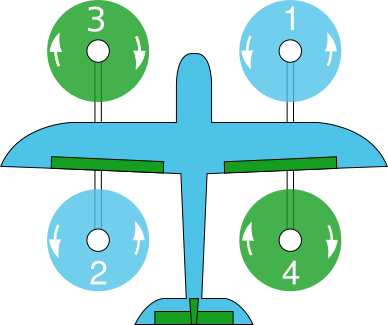 VTOL |
 Rover |
…and many more: helicopters, autogyros, airships, submarines, boats, and other experimental platforms. These frames have basic support but are not part of the regular flight-test program. See the full airframe reference.
Try PX4
Run PX4 in simulation with a single command. No build tools, no dependencies beyond Docker:
docker run --rm -it -p 14550:14550/udp px4io/px4-sitl:latest
Open QGroundControl and fly. See PX4 Simulation Quickstart for more options.
Build from Source
git clone https://github.com/PX4/PX4-Autopilot.git --recursive
cd PX4-Autopilot
make px4_sitl
Note
See the Development Guide for toolchain setup and build options.
Documentation & Resources
| Resource | Description |
|---|---|
| User Guide | Build, configure, and fly with PX4 |
| Developer Guide | Modify the flight stack, add peripherals, port to new hardware |
| Airframe Reference | Full list of supported frames |
| Autopilot Hardware | Compatible flight controllers |
| Release Notes | What's new in each release |
| Contribution Guide | How to contribute to PX4 |
Community
- Weekly Dev Call — open to all developers (Dronecode calendar)
- Discord — Join the Dronecode server
- Discussion Forum — PX4 Discuss
- Maintainers — see
MAINTAINERS.md - Contributor Stats — LFX Insights
Contributing
We welcome contributions of all kinds — bug reports, documentation, new features, and code reviews. Please read the Contribution Guide to get started.
Citation
If you use PX4 in academic work, please cite it. BibTeX:
@software{px4_autopilot,
  author    = {Meier, Lorenz and {The PX4 Contributors}},
  title     = {{PX4 Autopilot}},
  publisher = {Zenodo},
  doi       = {10.5281/zenodo.595432},
  url       = {https://px4.io}
}
The DOI above is a Zenodo concept DOI that always resolves to the latest release. For a version-pinned citation, see the Zenodo record or our CITATION.cff.
Governance
The PX4 Autopilot project is hosted by the Dronecode Foundation, a Linux Foundation Collaborative Project. Dronecode holds all PX4 trademarks and serves as the project's legal guardian, ensuring vendor-neutral stewardship — no single company owns the name or controls the roadmap. The source code is licensed under the BSD 3-Clause license, so you are free to use, modify, and distribute it in your own projects.
